Category: Needlepoint Stitches

The Best Threads for 13 Count vs 18 Count Needlepoint Canvas
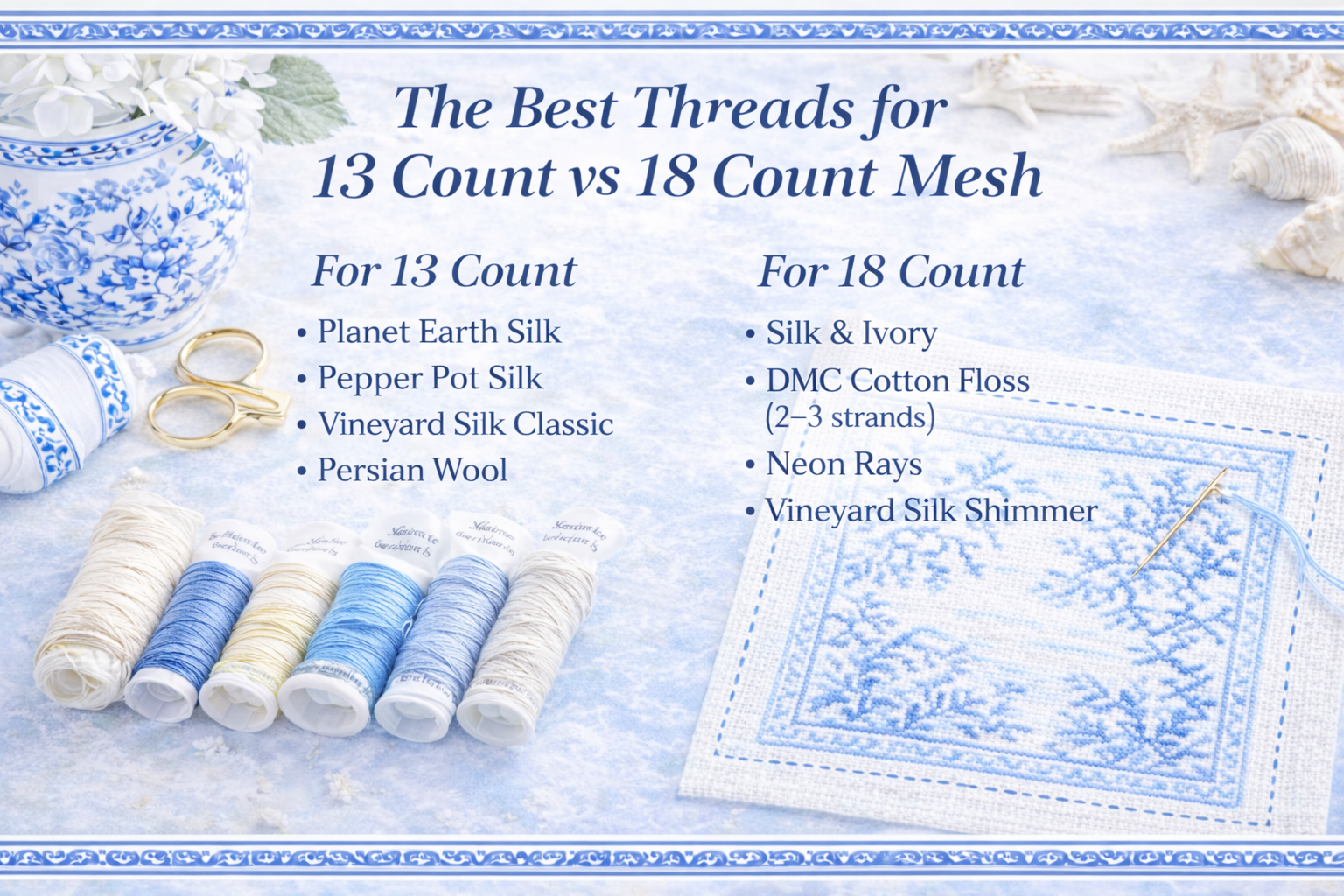
chatgpt image feb 14, 2026, 04 21 16 pm

Choosing the right thread for your mesh count is everything. Too thick? Your stitches look bulky and crowded. Too thin? You’ll see canvas peeking through — and nobody wants that.

Let’s break it down clearly so your stitches look smooth, full, and professional.


🧵 Best Threads for 13 Count Mesh

https://www.kcneedlepoint.com/cdn/shop/files/IMG_2955.jpg?v=1746582281&width=1080
https://www.stitchingfox.com/cdn/shop/files/Vineyard-Silk-Classic-001-090_2_1200x1200.jpg?v=1684435777

13 count mesh has larger holes, which means it needs a heavier thread to properly cover the canvas.

Top Thread Choices for 13 Count:

  • Planet Earth Silk
  • Pepper Pot Silk
  • Vineyard Silk Classic
  • Wool (Persian wool, crewel wool)

These threads are thick enough to give you beautiful, solid coverage without doubling strands.

Why These Work:

  • They fill the larger intersections cleanly.
  • They give a soft, plush finish.
  • They’re forgiving for beginners.
  • Coverage is typically perfect with one strand.

If your canvas is 13 mesh and you’re seeing canvas through your stitches, your thread is probably too thin.


🧵 Best Threads for 18 Count Mesh

https://needlepointjoint.com/cdn/shop/products/Silk_Ivory_91-100.JPG?v=1643053596
https://m.media-amazon.com/images/I/91PBXInbcHL.jpg
https://www.kcneedlepoint.com/cdn/shop/files/11_c98328a3-0a19-4eb0-b20a-430fa773b709.png?v=1769295966&width=1920

18 count mesh has smaller holes, so you need a finer thread for smooth coverage.

Top Thread Choices for 18 Count:

  • Silk & Ivory
  • DMC Cotton Floss (2–3 strands)
  • Neon Rays
  • Vineyard Silk Shimmer
  • Smaller weight silks

Why These Work:

  • They glide easily through tighter mesh.
  • They don’t bulk up intersections.
  • They create crisp, refined detail.
  • They allow for more stitch texture variety.

On 18 mesh, bulky thread will make your canvas stiff and distorted. Finer thread keeps everything elegant and balanced.


Quick Comparison Guide

Mesh CountHole SizeThread WeightLook
13 CountLargerHeavier silk or woolPlush, bold
18 CountSmallerFiner silk, cotton, specialtyDetailed, refined

Pro Tip for Perfect Coverage

Coverage isn’t just about thread weight — it also depends on:

  • Stitch type (Basketweave covers more fully than Continental)
  • Stitch tension
  • Fiber content (silk lays flatter than cotton)

When in doubt, stitch a small test area first. Your eyes will tell you immediately if the coverage feels right.


If you’re designing your own canvases (which I know many of you are 😉), choose your mesh count based on the final look you want:

  • 13 mesh → Bold, classic, traditional needlepoint feel
  • 18 mesh → Refined, detailed, heirloom finish

Both are beautiful. It’s just about intention.

Silk Thread

 Suitable for hand embroidery, cross-stitch, DIY crafts, making beautiful decorations for your bedroom/wall/home, you can also use them to make gifts for your lover, weave friendship bracelets for your intimate friends or decorate your braids and so on


We earn a commission if you make a purchase, at no additional cost to you.

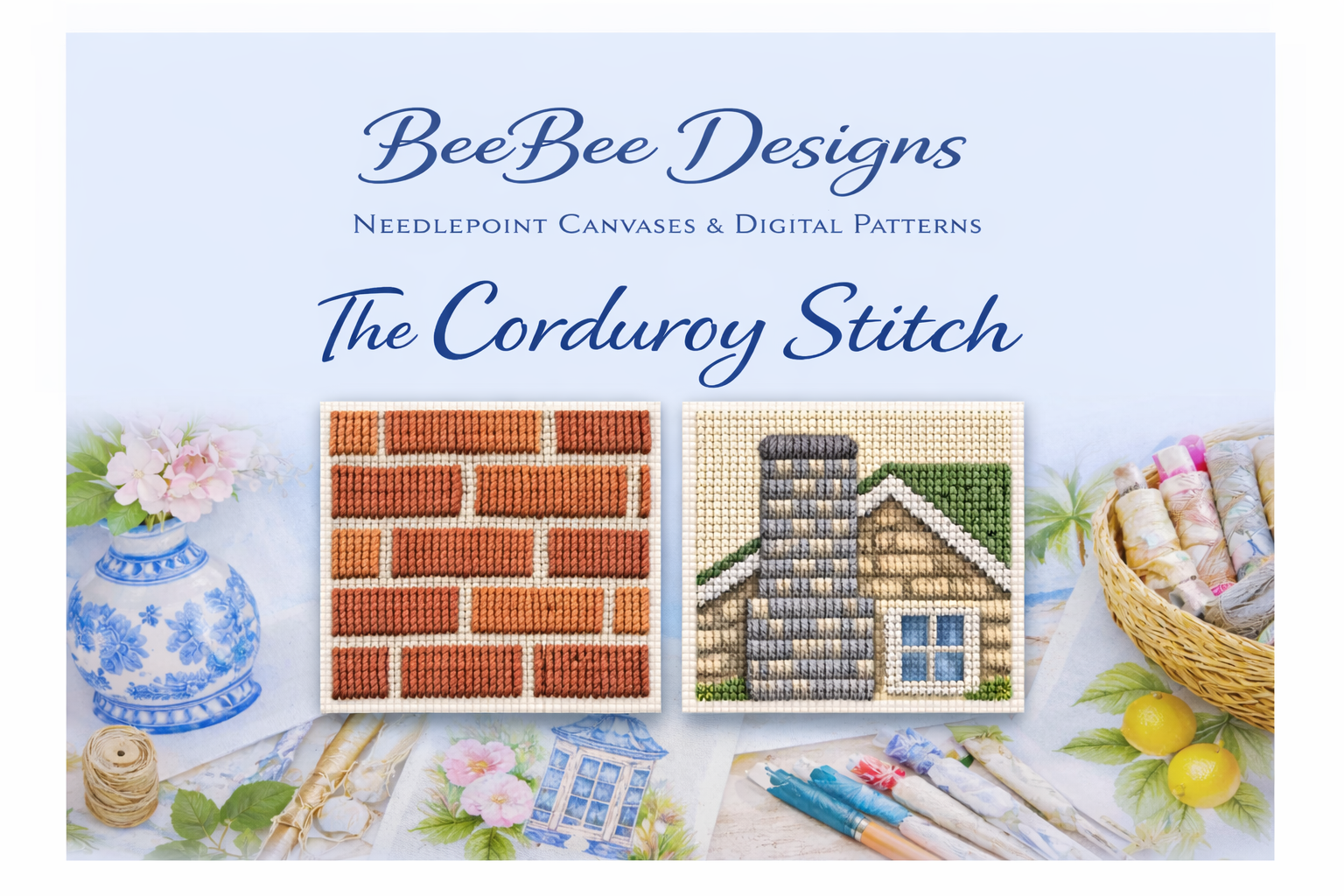
The Corduroy Stitch: Perfect Texture for Needlepoint Brick & Stone Walls

chatgpt image feb 11, 2026, 01 09 38 pm

If you love stitching architecture of little beach cottages, Nantucket houses, storefronts, lighthouses, or cozy cottages — the corduroy stitch is one of those underrated stitches that can seriously level up your texture game.

It gives you that subtle raised rib look that reads beautifully as:

  • Brick
  • Stone
  • Clapboard siding
  • Painted wood
  • Even chimney texture

And the best part? It’s way easier than it looks.


What Is the Corduroy Stitch?
https://cdn.shopify.com/s/files/1/0270/2547/3618/files/needlepoint_corduroy_stitch_tutorial_and_diagram.jpg?v=1713284611
https://www.kcneedlepoint.com/cdn/shop/articles/Tiny_Stitches_Upright_Cross_Stitch-31.png?v=1624642714&width=1080
https://cdn.shopify.com/s/files/1/0270/2547/3618/files/Corduroy_2.jpg?v=1740413299

4

The corduroy stitch is a layered straight stitch technique that creates vertical or horizontal ribs — just like corduroy fabric.

Instead of flat coverage like basketweave, you get:
✨ Dimension
✨ Light shadow play
✨ Architectural realism

It’s especially pretty on house canvases where you want the wall to feel alive, not flat.


Why It Works So Well for Bricks & Walls

Use corduroy horizontally → reads like rows of brick courses.
Add slight color shifts → instant aged brick look

Use corduroy vertically → perfect clapboard illusion.
Great for:

  • Coastal cottages
  • Preppy storefronts
  • Painted wood home

Use uneven color blends → gives natural stone depth.


Where To Use It On House Canvases

Try corduroy stitch on:

  • Exterior house walls
  • Chimneys
  • Foundation stone
  • Garden walls
  • Brick storefronts
  • Coastal shingle homes (looser version)

Thread Tips (From a Designer Perspective)

For crisp ribs:
✔ Use stranded cotton or silk (Pepper Pot is gorgeous here)
✔ Avoid super fuzzy fibers
✔ Slight overdye variation = chef’s kiss for brick

For softer painted house look:
✔ Silk + Ivory blends
✔ Matte cottons
✔ Slightly lighter background color behind ribs


Beginner-Friendly? Yes (With One Trick)

The key:
👉 Keep stitch length consistent
👉 Work in rows
👉 Don’t pull too tight (you’ll lose rib dimension)

Once you get the rhythm, it’s honestly relaxing — very “zone out and stitch your tiny dream beach house” energy.


The Continental Stitch: A Needlepoint Essential Every Stitcher Should Know

chatgpt image jan 25, 2026, 05 28 37 pm

Once you’ve mastered basketweave, there’s another stitch that deserves a permanent place in your needlepoint toolbox: the continental stitch. Simple, versatile, and endlessly useful, continental is one of those foundational stitches you’ll reach for again and again—sometimes without even realizing it.

What Is the Continental Stitch?

The continental stitch is a classic tent stitch, worked diagonally across a single canvas intersection. From the front, it looks nearly identical to basketweave and half-cross stitch, but the magic happens on the back of the canvas. Continental creates longer stitches on the reverse, giving it more coverage and stability than half-cross—while still being quicker and more flexible than basketweave.

Why Continental Stitch Is a Must-Learn

Think of continental as the stitch that fills in all the gaps—literally and figuratively.

It’s especially useful for:

  • Small areas and tight spaces
  • Details like faces, ornaments, letters, and trim
  • Curves, corners, and narrow borders
  • Travel stitching when moving from one area to another

While basketweave is ideal for large background areas, continental shines when precision matters. It allows you to maintain clean lines and smooth curves without distorting the canvas.

When (and When Not) to Use Continental

Continental is incredibly handy—but like any stitch, it works best when used intentionally.

Best uses:

  • Detail work
  • Outlines
  • Small motifs
  • Accents within a larger design

Use with caution:

  • Large background areas
    Using continental over large sections can pull the canvas out of shape over time. For those spaces, basketweave is still your best friend.

A good rule of thumb:
Big areas = basketweave. Small or detailed areas = continental.

How Continental Fits Into Your Stitching Journey

If basketweave is the backbone of needlepoint, continental is the connective tissue. Nearly every decorative stitch builds on these basics, so mastering continental makes learning more advanced stitches far easier down the road.

chatgpt image jan 25, 2026, 05 52 03 pm
Amazon
  • Thread guide tool: suitable for threading both hand and machine needles; Soft wire loop, easy to go through most kinds of needle eye holes; Convenient to use and help DIY your sewing
  • Threading helper: this little gadget makes threading a needle a lot easier when your eyesight is not as good as before, helpful to people who have trouble in threading
  • With storage box: convenient for storage needle threaders and keep them in place, then you don't need to find one everywhere when you need it
  • Flower head: about 0.9 inch in diameter, proper size for easy to hold by your thumb and forefinger; Bright colors make the needle threading tool easy to see; Note: each color's quantity may send randomly


We earn a commission if you make a purchase, at no additional cost to you.

The Woven Stitch ,Texture that Matters Most

chatgpt image jan 17, 2026, 04 36 27 pm

The Woven Stitch

Some stitches whisper.
The woven stitch? She speaks—softly, beautifully, with structure and soul.

If you’re looking to add rich texture, visual interest, and a little “how did you do that?” energy to your needlepoint, the woven stitch deserves a front-row seat in your stitch vocabulary.

Let’s break it down.


What Is the Woven Stitch?

The woven stitch is a decorative, surface-covering stitch that creates the look of interlaced threads—almost like a tiny basket or textile woven right into your canvas. Unlike basic tent stitches that lie flat, woven stitches add dimension and depth, making them perfect for areas you want to highlight.

Think:

  • Ginger jar bodies
  • Sweater details
  • Brick paths
  • Background panels
  • Rugs, baskets, or architectural elements

It’s classic. It’s elegant. And yes—it looks more complicated than it actually is.


Why Stitchers Love It

Here’s why the woven stitch has a loyal fan club:

  • Gorgeous texture – Raised but refined
  • Strong coverage – Minimal canvas peeking through
  • Visually interesting – Adds movement without chaos
  • Customizable – Change threads or spacing for different effects

This stitch is especially stunning in monochromatic or tonal color palettes, where the texture gets to shine without competing colors.


Best Threads for the Woven Stitch

Thread choice matters here—this stitch loves a little body.

Great options include:

  • Pearl cotton (sizes 5 or 8)
  • Silk blends
  • Wool or wool blends
  • Smooth cottons with slight sheen

Avoid anything too fuzzy or overly delicate—the stitch needs definition to keep that crisp woven look.


Where the Woven Stitch Works Best

This stitch thrives when it has room to breathe. It’s not meant for tiny, tight spaces.

Ideal uses:

  • Larger background areas
    • Repeating sections
  • Framed panels
  • Decorative borders

If you’re stitching a preppy-coastal or chinoiserie design (hi, welcome, you’re home), this stitch fits right in.his stitch fits right in.


Skill Level: Confident Beginner to Adventurous Stitcher

While it looks intricate, the woven stitch is very learnable once you understand the rhythm. If you’re comfortable counting canvas threads and following a stitch diagram, you’ve got this.

Pro tip:
Practice on a small sample first. Once your hands catch the pattern, it becomes almost meditative—over, under, repeat… very soothing, very chic.


Final Thoughts

The woven stitch is one of those techniques that elevates a piece instantly. It adds texture without shouting, structure without stiffness, and charm without trying too hard.

In other words:
It’s the needlepoint equivalent of a perfectly tailored linen blazer.

Classic. Timeless. Worth learning.

Stay tuned—more stitch tutorials, tips, and design inspiration are coming your way. And if you ever wonder “would the woven stitch work here?”
The answer is probably yes. 💙


screenshot 2026 01 17 162416

Amazon
  • Professional Needlepoint & Embroidery Aid】This precision thread guide helps beginners and experts alike achieve flawless cross-stitch and needlepoint results. Keeps embroidery neat, even, and visually stunning.
  • Wooden Laying Tool for Crafting.Made from smooth, splinter-free wood for lasting durability and a comfortable grip. Perfect as a sewing tool for long crafting sessions without hand fatigue.
  • Compact & Ergonomic Design.Measuring 16cm with a rounded 0.95cm end and ultra-fine 2mm pointed tip. Fits easily in kits and tackles detailed embroidery or delicate fabric work.
  • Effortless Thread Removal & Adjustment.Quickly unpick stitches or guide threads with the tapered tip. A must-have embroidery aid for beginners learning stitch correction or pros refining their work.


We earn a commission if you make a purchase, at no additional cost to you.

Lets Try the Basketweave

untitled design (28)

Basketweave Stitch: The Backbone of Needlepoint

If needlepoint had a little black dress, basketweave would be it. Timeless. Dependable. Quietly doing the most.

Basketweave is one of the very first stitches most needlepoint stitchers learn—and for good reason. It’s worked on the diagonal, it’s strong and durable, and it helps keep your canvas smooth and happy for years to come. Whether you’re stitching a coaster, ornament, pillow, or canvas that’s going to see real life, basketweave is your ride-or-die stitch.

What Is Basketweave Stitch?

Basketweave is a variation of the continental stitch, but instead of working straight across rows, you stitch diagonally, following the natural structure of the canvas mesh. This diagonal path is what gives basketweave its strength and prevents the canvas from warping.

On the front, it looks clean and even.
On the back? A woven, “basket-like” pattern (hence the name) that distributes tension beautifully.

Why Stitchers Love Basketweave

Let’s break down why this stitch is so beloved:

  • Beginner-friendly – Easy to learn and repeat
  • Sturdy & durable – Perfect for items that get handled
  • Prevents canvas distortion – No rippling or pulling
  • Great coverage – Especially on mono canvas
  • Versatile – Works for backgrounds, solids, and large areas

If you’re ever unsure what stitch to use… basketweave is almost always the right answer.

How Basketweave Is Worked

Basketweave is stitched diagonally, usually starting in one corner of an area and working your way across.

Here’s the rhythm:

  • You work up the diagonal for one row
  • Then down the diagonal for the next
  • Each stitch still goes over one intersection, just like continental
  • The direction changes, but the stitch stays consistent

Think of it like a gentle zigzag dance across the canvas—structured, but relaxed.

💡 Tip: Many stitchers follow a numbered path (like in the diagram above) to stay in rhythm and avoid losing their place. Once your hands learn the flow, it becomes second nature.

When to Use Basketweave

Basketweave shines in:

  • Backgrounds
  • Large solid areas
  • Coasters and ornaments
  • Pillows and belts
  • Anywhere durability matters

It’s especially great on 13- and 14-mesh canvas, but works beautifully on finer meshes too with the right thread choice.

Beginner Tips for Success

  • Use a laying tool or railroading for smoother stitches
  • Don’t pull too tight—let the stitch sit naturally
  • Turn your canvas if it helps you see the diagonal clearly
  • Trust the process—it looks better as the area fills in

Basketweave isn’t flashy. It doesn’t beg for attention. But it’s the stitch that quietly makes everything else work—and that’s real needlepoint wisdom.

Once you master basketweave, you’ve unlocked the foundation of needlepoint. Everything else builds from here. One diagonal stitch at a time. 💙

basketweave diagram

https://amzn.to/4qZDFCL

Amazon
  • Quickly unpick stitches or guide threads with the tapered tip. A must-have embroidery aid for beginners learning stitch correction or pros refining their work.
  • 【Idea for Multiple Tasks】Package includes 1 versatile laying tool, ideal for cross-stitching, needlepoint, and sewing projects. Use it to align threads, adjust fabric tension, or correct stitching errors.


We earn a commission if you make a purchase, at no additional cost to you.

Categories: Needlepoint Stitches